A first aid reference that is already on your phone
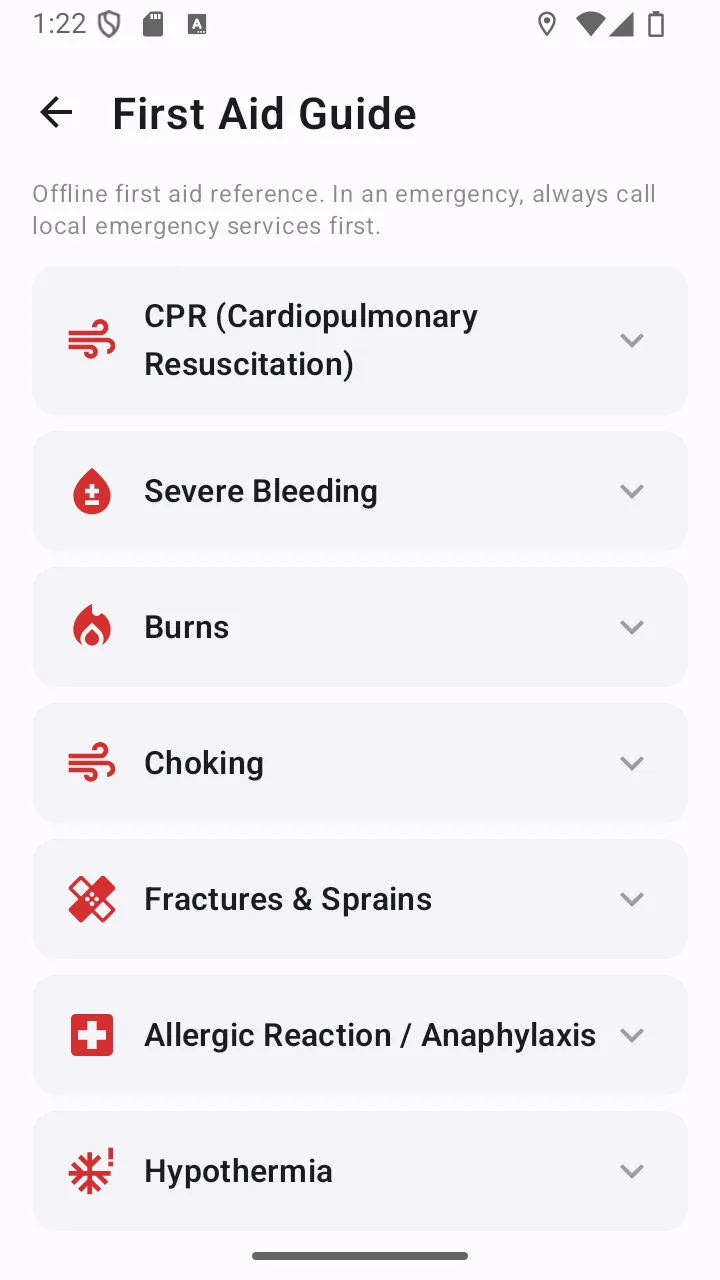
Searching for first aid guidance is something you do at the worst possible moment, often with one hand, sometimes with no signal. The guide is stored inside the app, so it opens instantly and works in a basement, a valley or on a plane.
It covers eight situations people most often face: CPR, severe bleeding, burns, choking, fractures, anaphylaxis, hypothermia and heatstroke.
The guide is stored inside the app. It opens with no connection.
Why it matters
Already downloaded
The content ships inside the app. No page load, no search results, no connection.
Scannable under pressure
Each procedure is written as short steps rather than paragraphs, because nobody reads prose while kneeling next to someone.
Alongside the emergency number
The app also stores emergency numbers for over 130 countries and detects your current one, so calling for help is not a separate hunt.
What it does, precisely
- Eight procedures: CPR, severe bleeding, burns, choking, fractures, anaphylaxis, hypothermia, heatstroke
- Stored inside the app — readable with no connection
- Step-based layout designed for fast scanning
- No permissions required
Permissions
Requested when you first use the feature — never at install.
- No permission required
- The guide is static content bundled with the app.
Limits
Stated plainly so you know what this feature does not do — not just what it does.
- A memory aid, not a substitute for first aid training or professional help.
- Call the emergency services first when you can — dispatchers can talk you through CPR and bleeding control.
Answers
First aid guide: common questions
Does the first aid guide work offline?
Yes. It is bundled inside the app rather than fetched from a website, so it opens with no connection of any kind.
Is this a substitute for first aid training?
No. It is a memory aid for people who have some idea what they are doing, and a starting point for people who do not. Hands-on training from a recognised provider such as the Red Cross, St John Ambulance or your national equivalent teaches things a screen cannot. If you have not taken a course, that is a far better investment than any app.
Should I read the guide before calling emergency services?
No. Call first, or have someone else call while you begin. Emergency dispatchers routinely talk callers through CPR and bleeding control in real time, and they can send help while doing it. The guide is for when you cannot reach anyone.
Which procedures are covered?
CPR, severe bleeding, burns, choking, fractures, anaphylaxis, hypothermia and heatstroke — eight of the most common situations where immediate action matters.
Related features
- Emergency numbersEmergency numbers for more than 130 countries, detected from your SIM and stored on the device.
- Medical informationBlood type, allergies, medications and conditions — stored on your device and attached to SOS alerts.
- SOS alertsA deliberate three-second countdown, then an SMS with your coordinates, a siren, and a location log.
- For familiesMedical details for each person, contacts that actually get reached, and a check-in that takes one tap.
- For hikingCompass, coordinates, a downloaded map and an SOS that sends a position rather than a guess.
- For everyday useOne app instead of five, for the small emergencies that are far more common than the big ones.
Related guides
- First aid basics everyone should knowA short list of the things that genuinely change outcomes, with a clear warning about the limits of learning this from a screen.
- Emergency preparedness: what should you actually keep on your phone?Most phone preparedness advice is a list of apps. The things that actually help are smaller, duller and take about ten minutes to set up.
Get first aid guide and 10 more tools
Free on Google Play. No account, no subscription, and the core tools keep working when the signal does not.
- 4.8 MB download
- Android 8.0+
- No account required